Here's a woman I can't stop thinking about. She's 74, lives in Diamond Heights, has COPD. October comes, the smoke rolls in for the fourth straight day, AQI over 150, and she's sitting in her apartment with the windows shut. No air purifier. No idea where the nearest clean-air shelter is. Her building was built in 1952. The HVAC hasn't been upgraded since the Clinton administration.
She is not hypothetical. Diamond Heights has the highest concentration of seniors in District 8. One in four residents is over 65. The buildings are mid-century. The ventilation is mid-century. The transit options are three bus routes the city is considering cutting.
I started looking into what other cities do when smoke arrives. And I found something that made me say, out loud, to nobody: wait, really?
A box fan and four furnace filters
A Corsi-Rosenthal box is a box fan with four MERV-13 furnace filters taped to the sides. It looks like a science fair project. It costs about fifty dollars. According to UC Davis testing, it delivers 600 to 850 cubic feet per minute of clean air, roughly ten times more cost-effective than the $155 unit Wirecutter recommends.
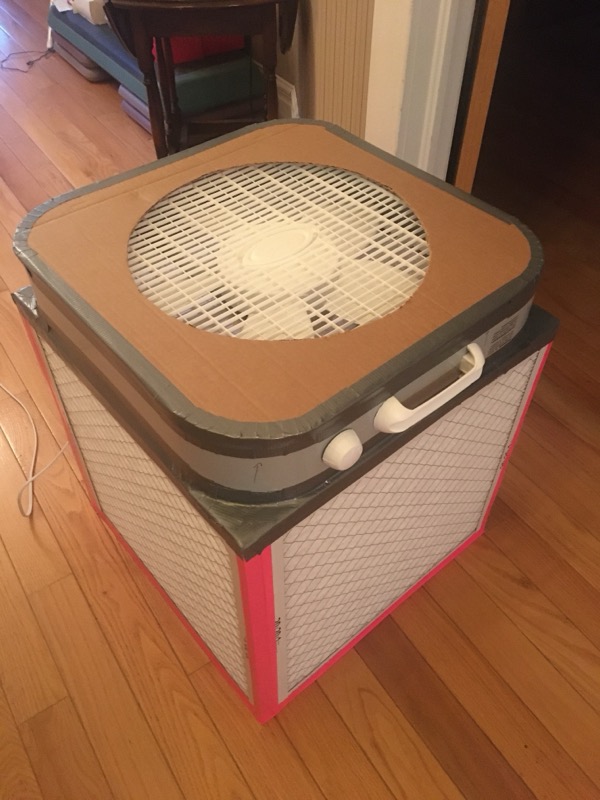
The Boise Fire Department distributes them. Flagstaff hands them out through its sustainability office. Fifty-nine percent of Flagstaff recipients had household incomes below $60,000; 60% had pre-existing health conditions. These are not pilot programs in progressive enclaves. Boise is the capital of Idaho.
San Francisco, a city that has won eight consecutive "A" ratings on global climate scorecards, has no program to get air purifiers to the people who need them when smoke season hits. No distribution system. No building-level air quality certification. Nothing.
I want to sit with that for a second. Because what follows isn't about blame. It's about a gap so obvious it's almost embarrassing.
The gap is adaptation, not ambition
San Francisco's climate ambitions are real. CleanPowerSF serves over 380,000 accounts with 100% clean electricity and has cut electricity-sector emissions by 98%. That is a genuine, major accomplishment, and I'll defend every dollar of it.
The problem isn't mitigation. It's what happens when the climate we're mitigating arrives anyway. The 2018 Camp Fire held the city's AQI above 150 for twelve consecutive days. Schools closed. Childcare cascaded into lost workdays for parents who had no backup plan. The 2020 fire season brought ten more days of unhealthy air. These aren't anomalies anymore. They're the schedule.
The mayor received a 2025 Mayors' Climate Protection Award for CleanPowerSF, a program the Breed administration built. He is now proposing to cut the Environment Department's General Fund allocation from $3 million to $545,000. That's an 80% reduction. Eight staff positions eliminated. The Climate Equity Hub, which funds green building retrofits for low-income households, zeroed out entirely.
Nobody running for D8 supervisor has mentioned any of this — as far as I can tell.
What I'd actually do (starting with the $50 thing)
The Corsi-Rosenthal program is where I'd start because it's the most embarrassingly simple intervention on my entire platform. Pre-stage filter materials at D8 fire stations before smoke season. Run neighborhood build events. Provide replacement filters annually. At $50 to $100 per unit, a $100,000 budget protects a thousand households. The coalition is unusual and I like it: fire department plus environmental health plus the maker community. No mandates. No controversy. Just air you can breathe.
Then: Clean Air Shelter certification. Imagine a letter-grade placard on the door of every café, gym, and coworking space in D8. An "A" means the filtration meets smoke-event standards. Seattle and King County launched their version in 2025. California's AB 836 allocated $5 million for a statewide clean air center network. We grade restaurants for food safety. We should grade buildings for breathability.
The business incentive writes itself. The café on 24th Street that upgrades its filtration doesn't just get a placard. It gets every customer in the neighborhood on the next smoke day. Public health infrastructure and competitive advantage, same investment.
And here's where I went down the rabbit hole
Once you start thinking about smoke as infrastructure — not as weather you wait out but as a recurring event you build for — other things click into place.
Parametric air quality insurance. The concept: the city purchases a policy that pays out automatically when AQI exceeds a threshold for a set number of days. No claims process. No FEMA paperwork. Cash within days. Fremont purchased parametric flood insurance in 2024, AM Best A+ rated, with only a 20% premium increase over traditional coverage. New York ran a pilot with Swiss Re in 2023 that deployed $1.1 million in emergency funding.
No U.S. city has done this for wildfire smoke. I'll say that plainly. The actuarial work to price smoke events is more complex than existing flood models, and I'm not going to pretend it's a sure thing. What I will say is that San Francisco has some of the most sophisticated municipal finance in the country and the kind of insurance industry relationships that could make this real. The feasibility study costs $50,000 to $100,000. That's the price of knowing whether it works.
One contractor visit, three problems solved
Here's the thing I keep coming back to. D8's problems live in the same building.
Take that homeowner in Noe Valley, early seventies, house built in 1940. It's not earthquake-safe — 81% of San Francisco's housing predates modern seismic codes, and she can't afford a $60,000 retrofit on a fixed income. The doorways are 28 inches wide, so when her mobility changes, she's trapped. The building has no smoke filtration.
Three problems. Three separate city programs that don't talk to each other.
Japan's Housing Finance Agency offers a product called Reverse 60: a reverse-mortgage-style loan for homeowners over 60. Interest only while you live there. Principal repaid when the home sells. The retrofit adds value. Nobody gets displaced. No U.S. city has adapted this for seismic work yet. I think San Francisco should be the first.
Now layer in a visitability standard for new construction: zero-step entries, wider doorways, one accessible ground-floor bathroom. Cost at construction: $100 to $600 per unit. Cost to retrofit those same features later: over $10,000. That's a 20-to-1 ratio. Every unit San Francisco builds under the Family Zoning Plan without these features is a unit we'll pay twenty times more to fix when the buyer turns 75.
A contractor doing a seismic retrofit is already in the house. The walls are already open. Adding smoke filtration, widening a doorway, installing a zero-step entry — the marginal cost drops to almost nothing when the work is bundled. One appointment. One contractor. Earthquake safety, air quality, and accessibility.
This should be the easiest yes on the page.
Why nobody's talking about this
District 8 voted 69% for the Great Highway closure, fifteen points above the citywide average. The constituency for serious climate policy is here. The candidates talking about it aren't.
I'm not running on climate because it polls well. I started reading seismic data and air quality reports and building cost analyses, and I kept finding the same thing: solutions that already exist in other cities, that cost less than what we're currently spending on not solving the problem, that nobody in San Francisco has proposed.
The fifty-dollar air purifier at the fire station. The letter grade on the café door. The financing product that lets a senior retrofit her home without losing it. The building standard that costs less than a kitchen faucet and means your home still works for you at 85.
A city that wins climate awards should be able to prepare for the climate it already has.